Steef
Nieuwe burenSteef is Rebecca’s husband, a police officer, and the father of their son, Sem. First introduced to Peter at a family gathering as a striking, physically confident presence, he later emerges as a man marked by a fatal mistake in Utrecht and its psychological aftermath. His bond with Peter begins in an unexpectedly intimate moment of shared smoking, but their connection is eventually broken by an intimate betrayal: Steef learns that his sperm has been used without his consent. His death at Peter’s hands turns that breach into one of the novel’s final and most devastating consequences.
Identity and Background
Rebecca introduces Steef as a notably tall, blond man with bright blue eyes, a tanned face, and a fit body beneath a loose white shirt. His firm, dry handshake and teasing remark about Peter’s lawn give Peter a first impression of someone at ease in his body and quick to speak. Peter, by contrast, worries that he must respond in a jaunty, spontaneous way. The encounter establishes an imbalance that is both social and physical: Steef seems comfortable taking up space, while Peter is preoccupied with how he appears.
Steef says he is forty, an age that Peter might not have guessed. He describes his move to a quiet municipality as the outcome of family life: Rebecca became pregnant, and she wanted their child to grow up outside the city, with fresh air, a garden, and friends. Steef says he agreed that his son should not grow up amid urban hardship. His description is not untroubled, however. He compares the new development to a graveyard, its coffins simply above ground. The house and suburban surroundings that offer a safer setting for his family also feel to him deadening and isolated.
Family Life and Peter’s First Bond
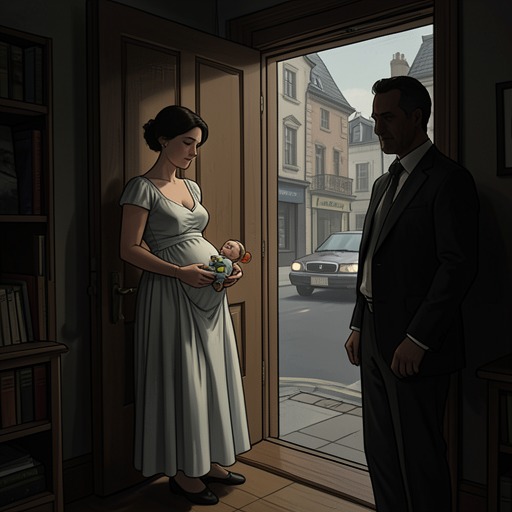
Steef and Rebecca have a young son, Sem. Family life shapes Steef’s account of the move, but it also places him within the novel’s larger concern with parenthood: his child is the reason he gives for choosing the suburbs, and later fatherhood becomes the ground on which he objects most fiercely to what has been done to him. He presents himself as someone who resisted being bound by a woman, only to say that Rebecca’s pregnancy changed the terms of his life. His account combines affection for his son’s needs with resentment at how decisively fatherhood redirected him.
Peter and Steef’s first genuine closeness comes not through a formal conversation but through a joint. Steef lays out three rolling papers, joins them together, adds hashish to tobacco, and prepares it while Peter watches, unsettled by Steef’s sudden burst of energy. Peter tells him he has not smoked for sixteen years. He recalls that Eva once blamed his excessive hashish use in adolescence for leaving him sterile; the warmth and familiar scent of the smoke nevertheless feel pleasurable to him. The two men smoke the joint down to its makeshift filter. Their silence feels to Peter like a wordless masculine pact, until Rebecca’s irritation calls Steef back to his own party. The moment offers Peter and Steef a provisional intimacy, made of shared ritual and silence rather than disclosure.
The Killing in Utrecht and Its Aftermath
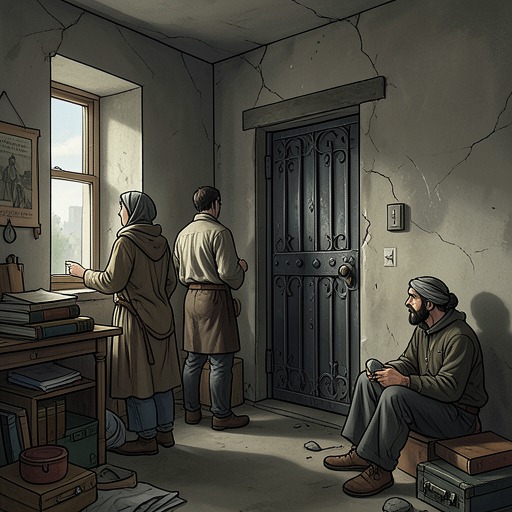
In a conversation about death, Peter asks Steef whether he has ever killed anyone. Steef’s jaw muscles tighten before he answers. He says that the previous year in Utrecht he mistook a drug user for an armed dealer and believed the man was drawing a weapon. What the man had drawn was a mobile phone. Steef says that afterward he fell apart: everything came out, and he was unable to work for months. The account complicates his self-presentation as a confident police officer. His work has brought him into a situation where a fatal misreading occurred, and the consequences continued long after the immediate event.
That history returns as a threat against his family. Peter and Eva wake to a violent disturbance outside: glass breaks, and a man shouts that he has found a filthy murderer. The accusation echoes the Utrecht killing, turning Steef’s private trauma into an external danger at the family home. Later, in a nightclub, Steef insists that hostile men from the former Yugoslavia are everywhere and still pursuing him. Peter watches him sway and begins to understand that Steef is not responding to a visible attacker; he tries to steady himself and establish that nobody has come out of the door. The scene shows the lasting force of Steef’s fear, while Peter’s effort to reassure him briefly reverses their earlier roles: Peter, usually consumed by his own thoughts, is the one trying to bring another man back to the present.
Reproductive Betrayal and the Final Confrontation
The four adults choose Steef and Rebecca’s home for a planned partner-swapping weekend. They regard the house as less frightening than a club, where strangers and difficult encounters would add pressure. Peter has hardly discussed the plan with Eva and doubts the choice as the date approaches. His thoughts circle around whether he has done the right thing with Steef, whether they should adopt, whether he can satisfy Rebecca, and whether he can bear to see Eva with Steef. The weekend therefore brings Steef into a situation Peter already approaches with anxiety, although the later conflict is not simply about sexual jealousy.
When Steef discovers that his sperm has been used to make Eva pregnant, he describes the act as theft and calls it criminal, emphasizing that Rebecca consented to what had happened. He rejects the idea that the women could decide what he would become without consulting him. His anger is specifically bound to fatherhood: he says he does not want the child and insists that a child needs a father. Earlier, he had spoken of his own son as the reason for moving and building a family life. Now the same importance of fatherhood sharpens his sense of violation. The revelation transforms the easy male solidarity Peter once felt while sharing a joint into a confrontation over consent, parenthood, and who has the right to make decisions about Steef’s life.
Steef also challenges Peter over the gun and the young man’s death. Peter threatens to tell Steef’s colleagues that he pursued the boy with a pistol; Steef laughs and says the actual perpetrator has been arrested that day and that he is no longer suspected. Peter’s rejoinder is that a police officer should not chase someone with a weapon in his free time. This exchange distinguishes Steef’s earlier killing from the separate death under investigation, while showing that his conduct with a gun remains a source of conflict even after he is cleared of suspicion.
Death and Narrative Role
Peter finds Steef’s Ford among the parked cars and interprets its presence as proof that Eva has left him for Steef. That conclusion belongs to Peter’s increasingly possessive account of events; it is not presented as an objective explanation of Steef and Eva’s relationship. Approaching the cottage, Peter sees Eva with Steef and reads her movements through his own jealousy and rage. Steef, meanwhile, tells him that Eva will go with them back home and offers to take the weapon, suggesting that no one else needs to know about it. Peter does not trust him.
The confrontation ends in gunfire. After Rebecca shoots Peter and he is wounded, he fires at her; when Steef springs forward and reaches for his hands, Peter pulls the trigger again. Steef collapses against the wall. His death is the final reversal of the apparent security attached to his home and family: the man who moved to protect his son from the dangers of the city dies in a domestic refuge, amid the consequences of deception, fear, and Peter’s escalating violence. Through Steef, the novel connects the aftermath of a mistaken killing to a later, deliberate act of violence, while showing how fatherhood can be at once a source of commitment and the point at which a person’s agency is most painfully contested.